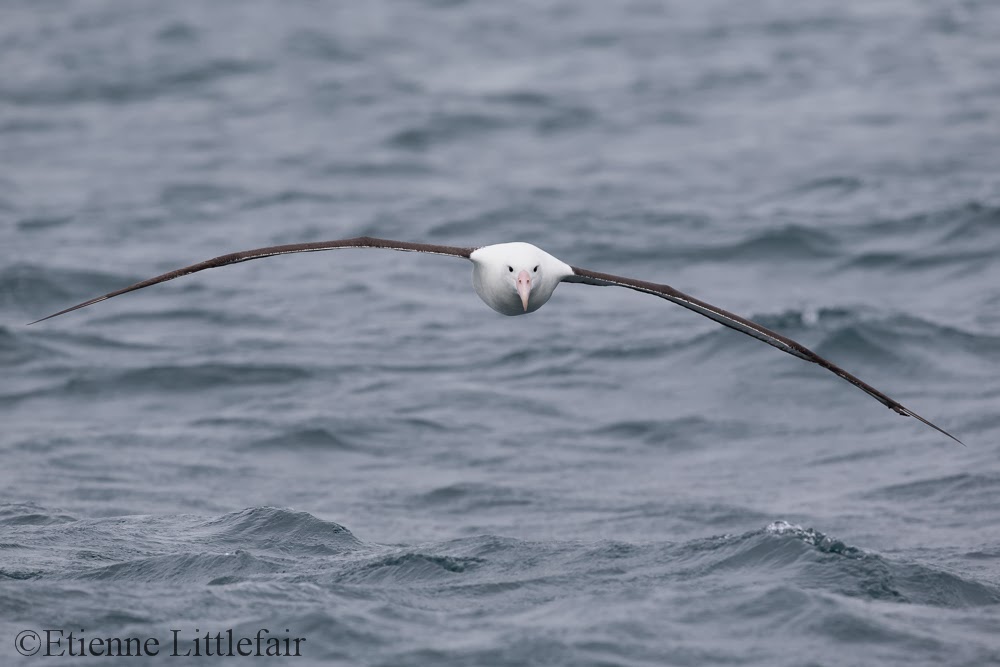
This post contains information regarding the identification of Northern (
Diomedia sanfordi) and Southern Royal albatross (
Diomedia epomophora) including comparative photographs. These species are huge and sit within the group known as the great albatrosses alongside the similarly sized Wandering Albatross species complex. One way of separating this species from the wanderers is to look for a black edge along the upper mandible of the bill - if present you have either a Northern or Southern Royal albatross. Distinction of adult Northern and Southern Royal Albatross can be achieved by examining the leading edge of the inner upper wing, which is distinctly white in adult Southern Royal Albatross. Southern Royal Albatross are also more humpbacked than Northern Royals and Wandering Albatross.
Both species range widely over the Southern oceans but are New Zealand breeding endemics, with most Southern Royals breeding on Campbell Island and most Northern Royals breeding on the Chathams.
The white edge of the inner upper wing can be seen clearly on the adult Southern Royal in the two images below.
Below is a younger Southern Royal with more black on its wings, the white leading edge is still prominent. Note the humpback, more prominent than in the adult Northern Royal Albatross (2nd shot down).
The photograph below shows the black edge along the inside of the upper mandible on a Southern Royal.
The bird below is an adult New Zealand or Gibson's Wandering Albatross (Diomedia antipodensis gibsoni), note the vermiculations along the back and the lack of any black on the mandible.
As Southern Royal Albatross age, their plumage becomes more white, below is a mature adult bird.
The photographs below shots an adult Northern Royal Albatross for plumage comparison. Northern Royal Albatross are the only great albatross to retain fully black upper wings in adult plumage.
Watching Southern Royal Albatross interact was an awesome and unforgettable experience.
These birds were all seen and photographed either from Kaikoura or to the East of Stewart Island.
Enjoy!