Whilst
sat here typing in Quito airport the feelings I am left with upon departing the
country are a sense of wonder and of inspiration derived from the scale
and beauty of the natural world I have witnessed in Ecuador, a sense of hope
having witnessed a successful community based conservation project, and finally
a sense of looming despair in the knowledge that some of the cultures I have
come to know and areas I have visited will likely soon be changed beyond
recognition and lost to the pages of history as the ever growing drive to
enhance economic prospects encroaches into the Amazonian lowlands in the form
of oil extraction.
One certainty is that after two months spent
living in various forests around the country I know I will return. Ecuador is a
country that biologically and geographically has it all – lowland tropical
rainforest to the east of the Andes, rising up into the cloud forest of the
Andean foothills, and higher into the dwarf forest, grasslands and glaciers of
the high Andes. To the west of the Andes lie the Chocoan lowlands known to some
as ‘the lost Amazon’ an incredibly species rich environment now sadly reduced
to around 2% of its former extent through various human activities. There is then
of course that famous Pacific coastline and the Galapagos Islands – an
archipelago that has continued to inspire biologists and nature lovers since
Darwin first drew the world’s attention to the islands all those years ago.
During a two month expedition, I conducted herpetofauna surveys with Operation Wallacea alongside a team of researchers from Sussex University. Our broad biodiversity surveys were focused on the cloud forests of Santa Lucia and the Amazonian
lowland forests inhabited by the Huaorani people to the west of the more well
known Yasuni National Park.
Santa Lucia is located in the western Andes in
the province of Pichincha, firmly within the Andean biodiversity hotspot. The
reserve is owned and run by 20 families within the local community whose
economy was historically largely based on agricultural produce, particularly
cane sugar production. In 1988 following a change in the legal status of the forest, the local people had to find alternate
means of income. One way in which this is now achieved is through tourism and
facilitation of scientific research in a sustainably run eco-lodge situated on
a panoramic ridge at around 2000m altitude. The stunning views from the lodge
give hope for the remaining forest whilst also paying homage to the large
tracts of Andean cloud forest that have been lost to the ever increasing human
needs for living space and agriculture.
The approximate location of Santa Lucia can be seen below.
The view to the S-SW away from the reserve reveals settlements and clearances at lower altitudes.
The image below shows the traditional method of sugar refinement from raw sugar cane. The mules provide the muscle required to operate the machinery into which raw sugar cane is fed. The mechanism then crushes the cane.
The highly concentrated sugar water crushed out of the plant stems then trickles from the machine into a container below..
The liquid can then be drank as a sugary drink, fermented into a type of rather tasty alcoholic rum or, using a set up similar to that pictured below, the liquid can be refined further. The wood burning stove here has a metal lined basin above into which the pure sugar cane juice is poured and then left to boil for several hours. This process separates the sugar from the water.
The
dominant habitat type present within the reserve is primary cloud forest, which
covers around 80% of the reserve, the remaining areas being pastures or
secondary forest that was previously farmed and is now reverting to its natural
state. The reserve covers a wide altitudinal band from around 1500m to 2450m
above sea level.
Here can be seen the view to the NW looking into the reserve.
The
location of the reserve makes Santa Lucia a key area for Spectacled bears, a species
classed as vulnerable by the IUCN. Santa Lucia is part of an initiative to form a ‘Bear
corridor’ facilitating seasonal movement of Spectacled bears from lower cloud
forest areas into the higher paramo zone. An important part of the Operation
Wallacea expedition was a camera trapping project run by Dr Mika Peck, the aim
being to recognise individual bears within the reserve by their facial
markings, allowing population estimates to be made. A link to the IUCN page on Spectacled bears http://www.iucnredlist.org/details/22066/0
Threats to Spectacled bears include habitat
degradation and direct persecution by landowners. Bears will occasionally
venture into agricultural areas and feed on crops, which leads to conflict.
Sadly in some areas bears are shot purely for sport. I am hopefully that the
establishment of the protected movement corridor will help to alleviate human
bear conflict. 18 additional species of medium to large mammal have been caught
on camera within the reserve.
The
staff at the lodge are passionate about the forest and wildlife of Santa Lucia,
the reserve manager Noe is a particularly knowledgeable ornithologist.
One particular highlight for any birder is the presence of Andean
cock-of-the-rock, of all birds, perhaps the most charismatic and sought after
species present in Andean cloud forest. There are also around 12 species of
hummingbird present including the dramatic Booted racquet-tail and Violet-tailed Sylph.
Whilst the birds and the large mammals are
perhaps more evident and certainly more well know within the reserve, the
reptiles and amphibians are certainly their equal in beauty and mystery. They also fulfill many important roles in the
ecology of the cloud forest. At Santa Lucia I identified 13 species of amphibian
including the Emerald Glassfrog (Espadarana
prosoblepon), the endangered Goblin Rainfrog (Pristimantis sobetes) and perhaps most significantly Eugenia’s
rainfrog (Pristimantis eugenia) and
the Dirty Rainfrog (Pristimantis illotus).
Eugenia’s Rainfrog being a species dependent on bromeliads known from only a handful of cloud
forest sites within an altitudinal range of only around 300m was a highly
significant find. The Dirty Rainfrog is more common further north in Colombia
but is only known from around 20 records within Ecuador, more spots on the
distribution map for a highly cryptic and localized species is always welcome
data.
Espadarana prosoblepon
Pristimantis sobetes
Pristimantis eugeniae
Pristimantis illotus
The observed absence of many of the potentially
present Hylidae and Centrolenidae species at the site indicates that
unfortunately something is amiss in the amphibian assemblage at the site. The
pristine state of large parts of the reserve would suggest that a disease such
as chytridiomycosis rather than human induced stochasticity is the
candidate likely responsible for ‘missing’ species. Chytridiomycosis is a
pandemic fungi that infects amphibians usually during the larval stage, where
it feeds upon keratin in the skin and damages the nervous system resulting in
reduced respiratory capacity and changes in behavior that combine to reduce
mortality and reproductive potential. Scientists first became aware of
Chytridiomycosis in 1993, though it is now known to have been at large since at least the 70's. Today it is known to have negatively
impacted amphibian populations in most habitats around the earth, in some cases
leading to extinctions.
I identified 13 reptile species at Santa
Lucia, the highlights being the two Anolis
species and three of the snake species.
Dipsas elegans - a Western Ecuadorean Andes endemic species.
Dendrophidion clarkii - this individual was found above 1500m, at the extreme upper limit of the species altitudinal range.
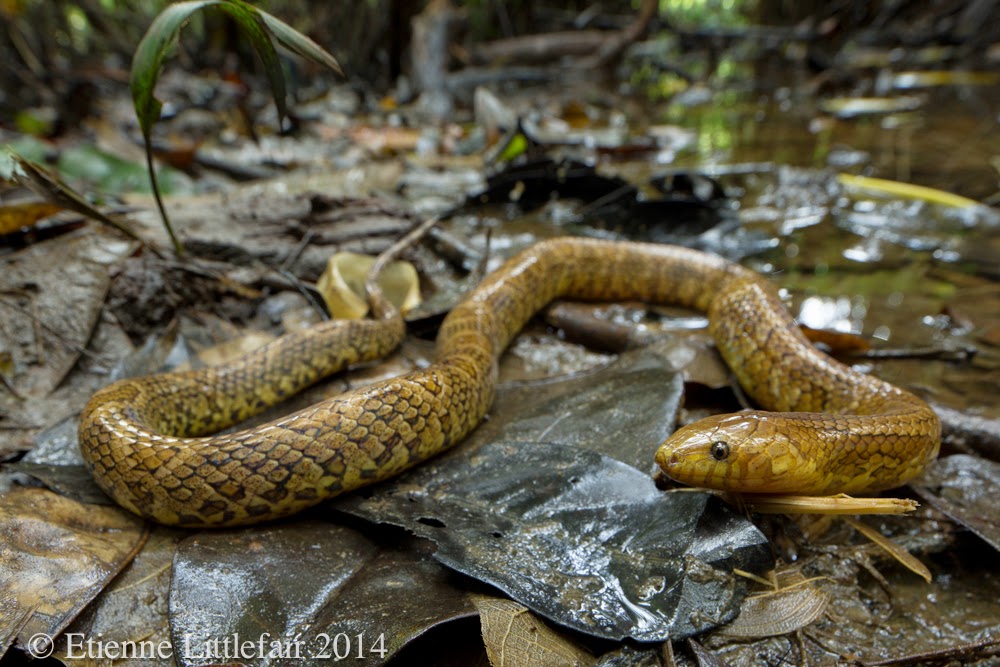
Atractus gigas - above and below
This final snake species was a massive herpetological highlight, the species was fist described by Myers and Schargel (2006) and has since been found only a handful of times, as of 2009 Santa Lucia was only the second site from which this species was known. A very beautiful and lucky find!
With continued investment from both tourists
and research groups such as Operation Wallacea and Sussex University, gladly,
the forests and wildlife of Santa Lucia are likely to be protected well into
the future. The reserve is one of the most successful and promising examples of
sustainable community based conservation that I have had the pleasure of
visiting and contributing to. I thoroughly recommend a visit to Santa Lucia for
anyone with a love of nature and the outdoors.
A
final parting image that captures the beauty and mystery of the Santa Lucia
cloud forests.
Please
contact me for more information on Santa Lucia, the Santa Lucia website can be
found here http://www.santaluciaecuador.com/
Yasuni National Park has recently received a
lot of media attention due to the decision made by the Ecuadorian government to
allow oil exploration and extraction to take place within the reserve,
facilitated by the development of a new road. The negative environmental consequences
of this new road development are all too predictable, having been seen time and
again in tropical areas around the world. Having spent time with the wildlife
and both the Quechua and Huaorani peoples indigenous to the area, and upon
whose traditional lifestyles and cultures this decision will weigh most
heavily, I feel more motivated than ever to further my involvement in
conservation and natural resource management. Seeing the ‘waste’ natural gasses
being burned off, and the swathe of recent deforestation and degradation along
the oil road leading from Coca into Amazonian Ecuador is enough motivation to
banish away any apathy. On this note, I plan to return to Ecuador in November
to a rare fragment of intact Chocoan lowland forest home to the last of the
critically endangered Brown-headed spider monkeys where I will aim to
photograph the species and produce an article alongside Dr Mika Peck of Sussex
University regarding his long term effort to conserve the species and their
habitat into the future – an ongoing project with a promising future.
Some articles concerning Ecuador’s recent oil
extraction policies can be found here.
http://www.sosyasuni.org/en/index.php - sosyasuni is an Ecuadorean NGO with the aim of keeping oil companies out of Yasuni.
http://www.theguardian.com/environment/2014/may/23/ecuador-amazon-yasuni-national-park-oil-drill - Guardian article 'Ecuador signs permits for oil drilling'
The Huaorani of Nenkepare were the people we
worked closely with in the lowlands. Nenkepare is a small settlement established
around 20 years ago by a forward thinking Huaorani named Nenke to prevent illegal
encroachment into the legally protected Huaorani land.
Whilst
the location and boundary of the Huaorani zone is clearly marked on this map I
photographed at Apaica - another Huaorani village, in practice, the boundary is currently
subjective as there are no markers of boundary fences on the ground. This lack
of an established border has recently enabled certain industries to start
‘testing the water’. The Huaorani have encountered oil exploration within their cultural territory. I for one do not wish to see
an ancient culture along with the vast assemblage of species living in sympatry
descend into a maze of oil roads, pipes, toxic streams and poverty.
Two
weeks of camera trapping around the Nenkepare area revealed some of the
difficult to see mammal species present with such highlights as Jaguar, Tapir
and again Puma.
The Huaorani regard Jaguars as their brothers, kindred spirits. They therefore do not hunt the species, making the Huaorani cultural reserve a highly important area for this charismatic and threatened large cat.
This Tapir was captured on camera approaching a clay lick, an area of exposed clay which is frequented by many species of bird and mammal in order to gain dietary salt, a hard to come by resource in the Amazon basin.
The Amazonian lowlands are also home a treasure trove of herpetofauna. Within 4km of our field camp, I identified close to 100 species over three weeks of surveys. Some highlights below.
Hypsiboas boans - Gladiator treefrog
Phyllomedusa vaillantii - White-lined monkey frog
Pristimantis carvalhoi - English name?
Edalhorina perezi - Perez's snouted frog
Edalhorina perezi - Perez's snouted frog
Melanosuchus niger - Black caiman
Anolis fuscoauratus - Slender anole, seen here shedding its skin.
Atractus major - Big ground snake
Visiting the tropics and seeing first hand the profusion of life and the conservation issues we are faced with in the 21st century is a life changing experience. It is tempting to think from our living rooms in Europe and North America that all is well in the natural world when we turn on the television and watch David Attenborough. The reality is that if we want to maintain our planets wildlife and ecosystems into the future, for ourselves, for future generations, and to allow the infinite possibilities of evolution to unfold, we have to take a stance and use the power we hold as citizens of democratic political domains to petition and vote in such a way that policy makers know what is at stake, and know the importance that we as people place on the continuation of the natural ecosystems of the world. The decisions you make in everyday life, the food and coffee you buy in the supermarket, all these things have environmental implications. Everything we use is produced somewhere, by someone, in more or less environmentally friendly ways. The current oil extraction in Ecuador is in the end fuelled by the international market, and that includes you and me. I urge my readers to take a stance, shop wisely, become a voice in support of nature through your political entitlements and the lifestyle you choose to live.
Thank you for taking the time to read this post. If you are a High school student or an undergraduate student, you may be interested in Operation Wallacea, a UK based conservation charity which runs expeditions in which students partake as research assistants to several tropical countries. Their work along with students contributions supports the work and development of young scientists such as myself. You can find their website here http://opwall.com/
Finally, thank you to Mika peck for the camera trap images, and thank you to Operation Wallacea for organising and facilitating the expedition.


.jpg)
%2B082209.jpg)